

Indigenous Climate Action (ICA) is an Indigenous‑led, rights‑based organization working to advance climate justice by centering Indigenous knowledge systems, sovereignty, and self‑determination. Rooted in the lands now known as Canada, ICA develops programs, resources, networks, and capacity to empower Indigenous communities to lead solutions to the climate crisis. Through education, research, and community‑driven programming, ICA works to restore Indigenous leadership and governance in climate policy and environmental decision‑making.
In this conversation, Executive Director Eriel Deranger reflects on leadership, movement strategy, philanthropy, and the role of Indigenous solutions in the post-2030 Agenda. The Ban Ki-moon Foundation partners with ICA through our AMPLIFY strategy, helping to elevate Indigenous youth priorities in shaping climate policy and practice.
“For me, leadership is about the collective movement for the liberation of our Peoples and the survival of our cultures, identities, and the planet. It is a heavy responsibility, and not one that should be stepped into from a desire for personal success, but from a collective purpose.”
- Eriel Deranger on Leadership
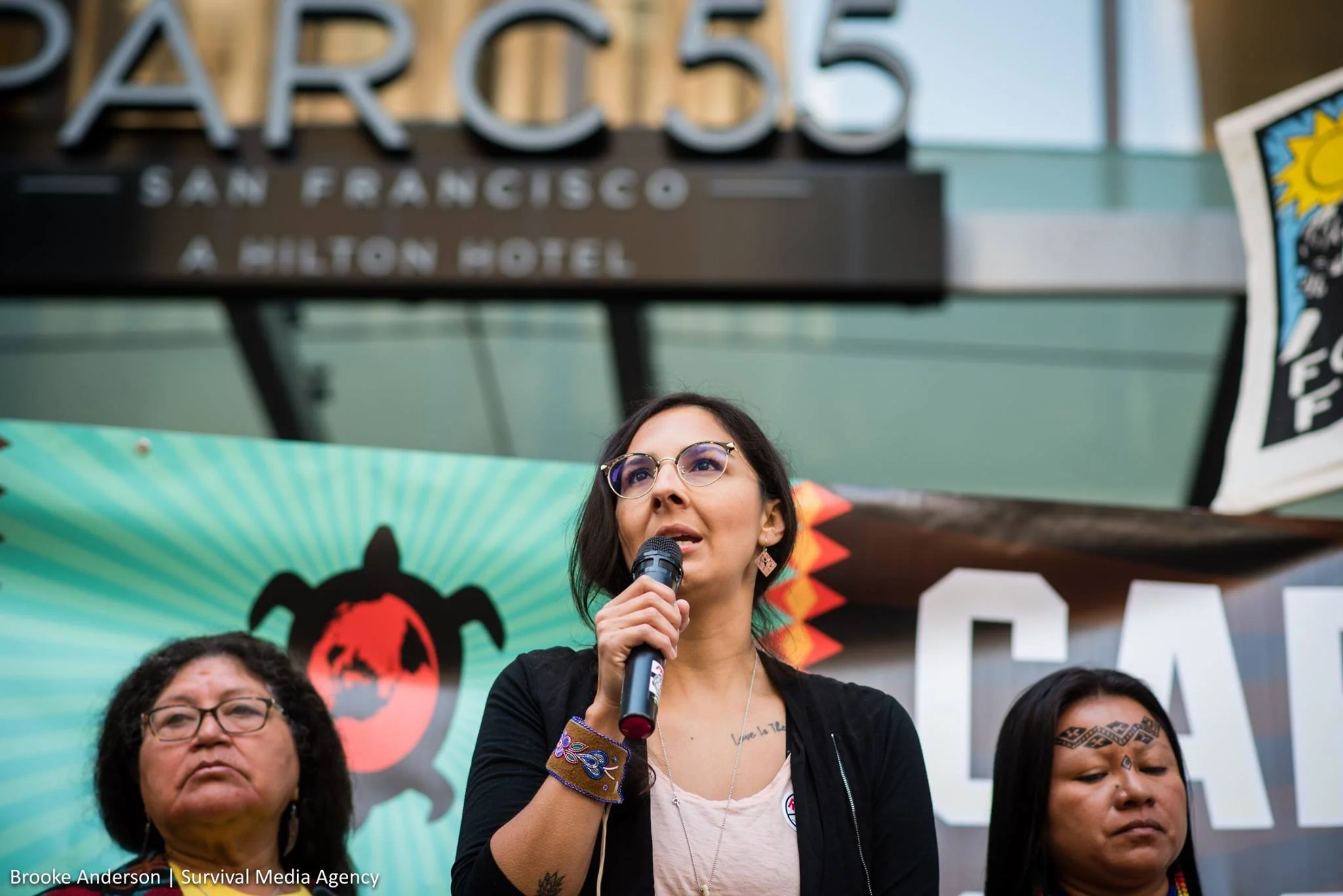
Photo Credit: Brooke Anderson / Survival Media Agency
We would love to hear about your journey as a leader — both in your community, and as a leader of ICA. What key moments or experiences have shaped your path?
My family is large and interconnected. My dad was one of 19 children from the Athabasca Chipewyan First Nation. In my community, it feels like I cannot throw a rock without hitting a cousin. Leadership in our family was grounded in consensus. We are also matriarchal. My grandmother, Therese Deranger, was the center of our family. Her leadership came from responsibility, not authority. Her home was a place of safety and care, and that shaped my understanding of what leadership means.
In our current system, leadership is often associated with domination, authority, corporate advancement, notoriety, or wealth. That has never been the kind of leadership I aspired to. My understanding of leadership comes from my community and my family.
Because of this, I resisted leadership roles for a long time. I was offered several leadership positions before I was 30 and turned them down because I did not want the responsibility of others. My first major leadership role was as spokesperson for my Nation, a position I held for six and a half years. I was guided by elders, our chief and council, and the community. It required care in how I represented the complexities of our people.
Eventually, when I became Executive Director at ICA, I brought these lessons with me. I wanted to build a model of leadership rooted in ‘power with’ rather than ‘power over’. It means holding space for discomfort and dialogue, being truthful about failures, and being responsible for those you speak for. For me, leadership is about the collective movement for the liberation of our Peoples and the survival of our cultures, identities, and the planet. It is a heavy responsibility, and not one that should be stepped into from a desire for personal success, but from a collective purpose.
Could you share more about the work of ICA – how ICA came to be, your major successes, what you are most proud of, and what comes next?
ICA emerged from frustration with the traditional environmental movement. Before working for my Nation, I worked with several environmental organizations, and while they were shifting toward greater inclusion of Indigenous Peoples, much of the work remained performative or tokenistic.
Indigenous staff were educating entire sectors on why Indigenous rights mattered. Most of our time was spent bringing non-Indigenous NGOs up to speed, instead of building capacity in our own communities. Our leaders did not have the foundational knowledge needed to participate in global climate discussions like the ones leading up to the Paris Agreement. This concerned me.
I eventually left the environmental movement and worked for my Nation, serving as the Environmental NGO liaison to integrate these organizations respectfully into our campaigns and ensure they followed free, prior, and informed consent (FPIC). As my community became increasingly visible and successful in challenging the Alberta tar sands, we became well known, and other communities started reaching out. They wanted support to build campaigns; attract attention to issues like those affecting Grassy Narrows or the Wet'suwet'en territories; and understand how to organize effectively.
In January 2016, shortly after the Paris Agreement was adopted, we organized a national gathering with 150 Indigenous people. We talked about climate change solutions from the UN level to local strategies. Many participants expressed feeling excluded from discussions as well as decisions on both the causes and the solutions to the climate crisis. They wanted sustained support for learning and leadership development. That gathering became the foundation of ICA.
ICA became the only Indigenous-led climate justice organization in Canada dedicated to creating spaces for Indigenous knowledge exchange. From that grew our Climate Leadership Program, which centers Indigenous rights, culture, values, and cosmology. It reframes climate change as an outcome of colonization, not only from rising greenhouse gases. Its core message is that colonialism causes climate change and Indigenous rights are the solution.
From this program, we built research initiatives like Decolonizing Climate Policy and extensive youth programming through our Youth Advisory Council. We analyze how Indigenous Peoples are included in Nationally Determined Contributions (NDCs), divestment movements, and environmental movements. We examine how these spaces continue to perpetuate the same patterns that led us to create ICA.
We also uplift Indigenous-led solutions beyond technology like solar or wind. Solutions include cultural revitalization, language revitalization, and sovereignty. These allow us to apply our relationship-based leadership instead of colonial models of power. We build storytelling platforms through podcasts, social media, and videos, and create land-based gatherings that reconnect people with culture, ceremony, and intergenerational knowledge. Our theory of change combines strategic disruption of harmful systems with capacity building within our communities. Where those two approaches meet is where something new emerges. That is the heart of ICA.
“Communities often receive funding only when they can prove harm. This leads to project-based, surface-level solutions rather than systemic change. But the systems that allow harm to occur are what need to be transformed. We need funding for infrastructure so our communities do not depend on intermediaries. ”
- Eriel Deranger on her call to action to funders.
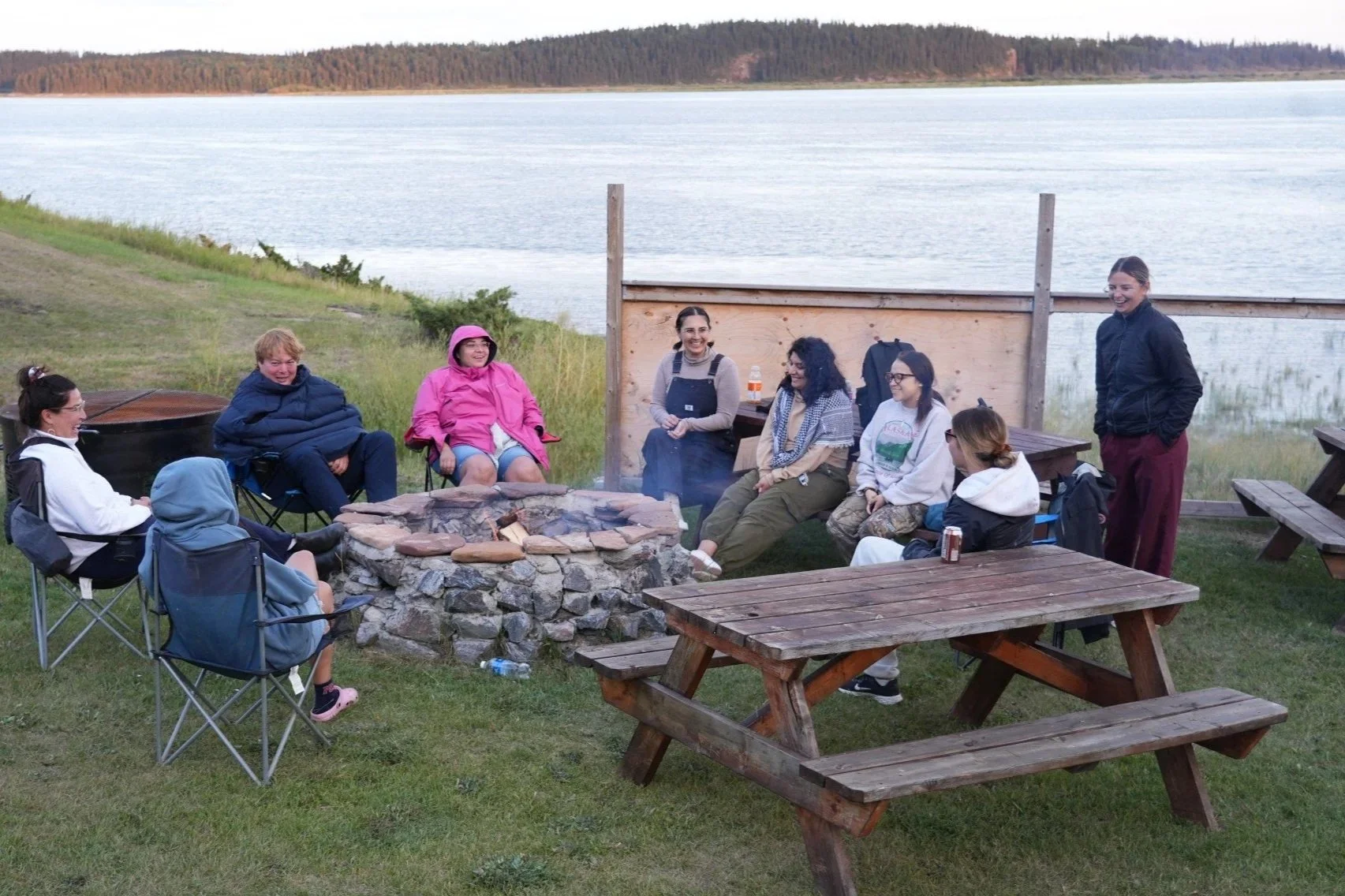
Photo Credit: ICA
You spoke at a recent event hosted by the International Funders for Indigenous Peoples (IFIP) network, as well as at Climate Week NYC, about unlocking larger streams of climate justice funding within philanthropy. What is your call to action for funders?
Since 2007 and the adoption of the UN Declaration on the Rights of Indigenous Peoples, and with the recognition of the International Indigenous Peoples Forum on Climate Change, Indigenous Peoples have gained visibility in global processes. But philanthropy has not matched that shift. The 2024 IFIP report shows that only 0.6% of global giving goes to Indigenous Peoples, and of that amount Indigenous governments, autonomous regions, and Indigenous Peoples organizations receive only 0.3% directly, with the majority routed through intermediaries.
Indigenous Peoples have been excluded from governance, education, conservation, science, technology, and environmental movements for centuries. We do not have the institutional infrastructure that large organizations like Greenpeace or Sierra Club have. Our work is more complex because it is rooted in rights-based frameworks that intersect across all sectors.
Communities often receive funding only when they can prove harm. This leads to project-based, surface-level solutions rather than systemic change. But the systems that allow harm to occur are what need to be transformed. We need funding for infrastructure so our communities do not depend on intermediaries.
Funders often support projects and crises, but not the capacity building needed to build a strong Indigenous rights-based movement. Without that foundation, change cannot be scaled. We are tired of receiving project-based funding for surface issues like mosquito nets or water filters while major global frameworks on climate finance and Just Transition are negotiated without us. Funders should support both immediate needs and our full participation in decision making. Our youth need more fellowships that support them while also resourcing the projects they want to lead. We need resources to understand global frameworks like the Paris Agreement and the SDGs and to build institutions that can hold and share that knowledge strategically. We need resources to eliminate coercive systems, to ensure we are informed well in advance, and to guarantee that the knowledge we bring to the table is treated as essential to decision making.
For example, Real Free, Prior, and Informed Consent (FPIC) requires being free of coercion, intimidation, and manipulation; being informed with all necessary knowledge, including our knowledge systems; and being involved prior to decisions. Instead, FPIC has been reduced to what I call “FPI small C,” which is often just prior and informed consultation. In many cases, they do not even do that. They simply ask whether a conversation took place, and that is used to justify decisions. Our communities need investment in the full “FPI” (free, prior, and informed) part of FPIC.
This is not a national issue. It is global. Indigenous Peoples have been separated across borders, and we need global rights-based strategies that align across regions. The gap is that there is no funding to connect these strategies across borders or build collective infrastructure.
Can you speak more to why it is important to work across the border between the United States and Canada, especially at this moment?
Indigenous rights do not follow colonial borders. My people, the Dene, are part of the Athabaskan language group that extends from Alaska to Mexico. Our people traveled, traded, and held ceremonies across these lands for millennia. Colonial borders were imposed later and are arbitrary constructs.
Indigenous Peoples often call the US-Canada border the Medicine Line. During the American Indian Wars, Native Americans fleeing violence would cross into Canada, and as soon as they crossed the border the US cavalry would stop pursuing them. People saw it as a powerful line, but in reality our people always moved freely across these lands.
In this moment of historical erasure, rising repression, and the global resurgence of authoritarianism, Indigenous Peoples must come together across borders. These systems are beginning to crumble, and Indigenous cultures offer a powerful vision beyond colonial frameworks. That vision often provokes backlash from those invested in power over others.
Supporting Indigenous youth is also critical. They need to know that assimilation into colonial systems is not the only future. They should be supported to imagine futures grounded in what existed before colonization. Our history is our future. We must reconnect intergenerational knowledge disrupted by residential and boarding schools.
ICA’s Climate Leadership Program includes participants from both sides of the Medicine Line. We collaborate with NDN Collective, Indigenous Environmental Network, and the International Indian Treaty Council to advance rights-based frameworks. Our land camps bring people together in ceremony and solidarity. We do this because extractive industries do not respect borders. These days, pipelines cross borders more easily than people. Our resistance must be cross-border as well.
“We need resources to understand global frameworks like the Paris Agreement and the SDGs and to build institutions that can hold and share that knowledge strategically. We need resources to eliminate coercive systems, to ensure we are informed well in advance, and to guarantee that the knowledge we bring to the table is treated as essential to decision making.”
- Eriel Deranger on Indigenous participation in global frameworks
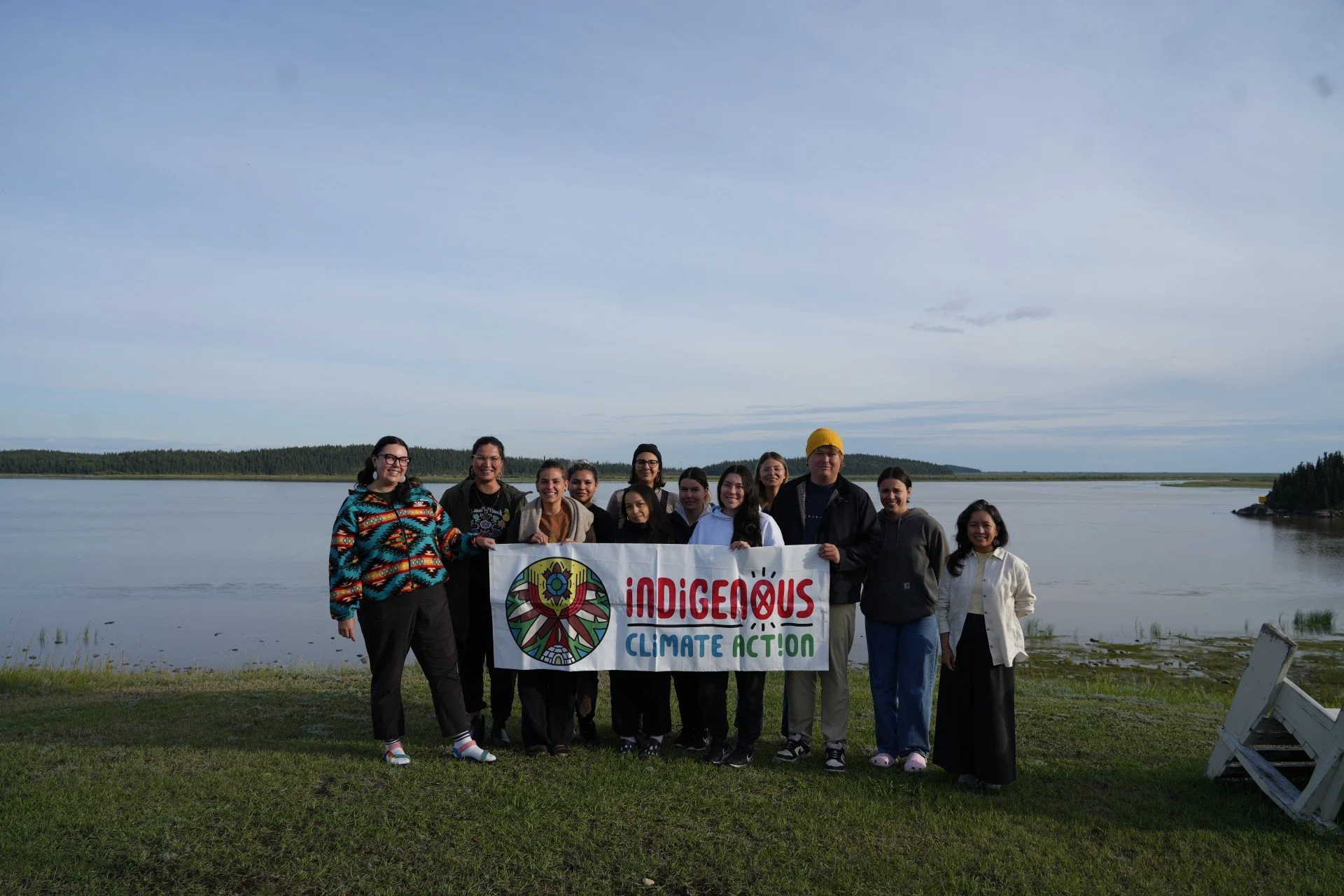
Photo Credit: ICA
As you know, the work of the Ban Ki-moon Foundation is to continue the legacy and leadership of our Founder and Chair on the Sustainable Development Goals and Paris Climate Agreement. From your perspective, what does his leadership and legacy mean for the world, for your work, and the issues we are trying to advance?
One of the things I value most about Ban Ki-moon’s work is his consistent advocacy for equity and justice. At the heart of the SDGs is the principle that no one gets left behind and that we must address inequalities. That approach influenced the negotiations and outcomes of the Paris Agreement, which encourages a more holistic view of the climate crisis.
Indigenous Peoples were one of the nine major groups shaping the SDGs and were deeply involved in the Paris Agreement. That is a significant achievement in global equity and inclusion. The SDGs include several direct references to Indigenous Peoples, our cultures, languages, and knowledge. Seventy-three of the 169 targets connect to the UN Declaration on the Rights of Indigenous Peoples. There is also a clear call for Indigenous Peoples to be actively engaged in implementing and reviewing the SDGs. The Paris Agreement includes similar recognition.
With 2030 approaching quickly, what reflections do you have on advancing this work? What should the Post-2030 Agenda look like, building upon the legacies of these two historic frameworks?
We are less than five years away from 2030, and many of the ambitions within these targets will not be met. One of the biggest challenges for Indigenous rights movements across climate justice, sustainable development, and international advocacy is that the SDGs, the Paris Agreement, and UN systems do not affirm Indigenous Peoples’ collective rights to our lands, territories, and resources - which is essential for climate solutions. They affirm that we have collective rights, but not to the land and resources that sustain us. There are no specific targets that speak directly to Indigenous security in this way.
UNDRIP represents the bare minimum standard for Indigenous rights, yet many people treat it as the gold standard. It is actually the starting point. We need to be investing in what comes after the bare minimum and imagining what Indigenous self-determination looks like beyond these limits.
These are the structures we currently work in, but they cannot be the boundary of what we imagine. The next stage requires redistributing power and resources that have been held within systems for more than 500 years.
My biggest challenge to all leaders working on equity, is to ask: how do we move toward justice when some Peoples do not want to participate in existing systems? What would it look like to imagine the SDGs or the Paris Climate Agreement outside colonial economic structures? Indigenous communities developed complex systems of governance, science, agriculture, medicine, education, and trade for thousands of years before colonization. Instead of drawing from those systems as roadmaps for the future, colonial systems tried to erase and devalue them.
It is time to expand our imagination and create space for Indigenous knowledge to inform global solutions. Ban Ki-moon’s work laid important foundations for addressing inequality. Now, we need to empower the next generation to carry that courage forward and take it to the next level.
As we wrap up, are there any final reflections or calls to action you would like to leave us with?
“It is time to expand our imagination and create space for Indigenous knowledge to inform global solutions. Ban Ki-moon’s work laid important foundations for addressing inequality. Now, we need to empower the next generation to carry that courage forward and take it to the next level.”
- Eriel Deranger on building upon Ban Ki-moon’s Leadership
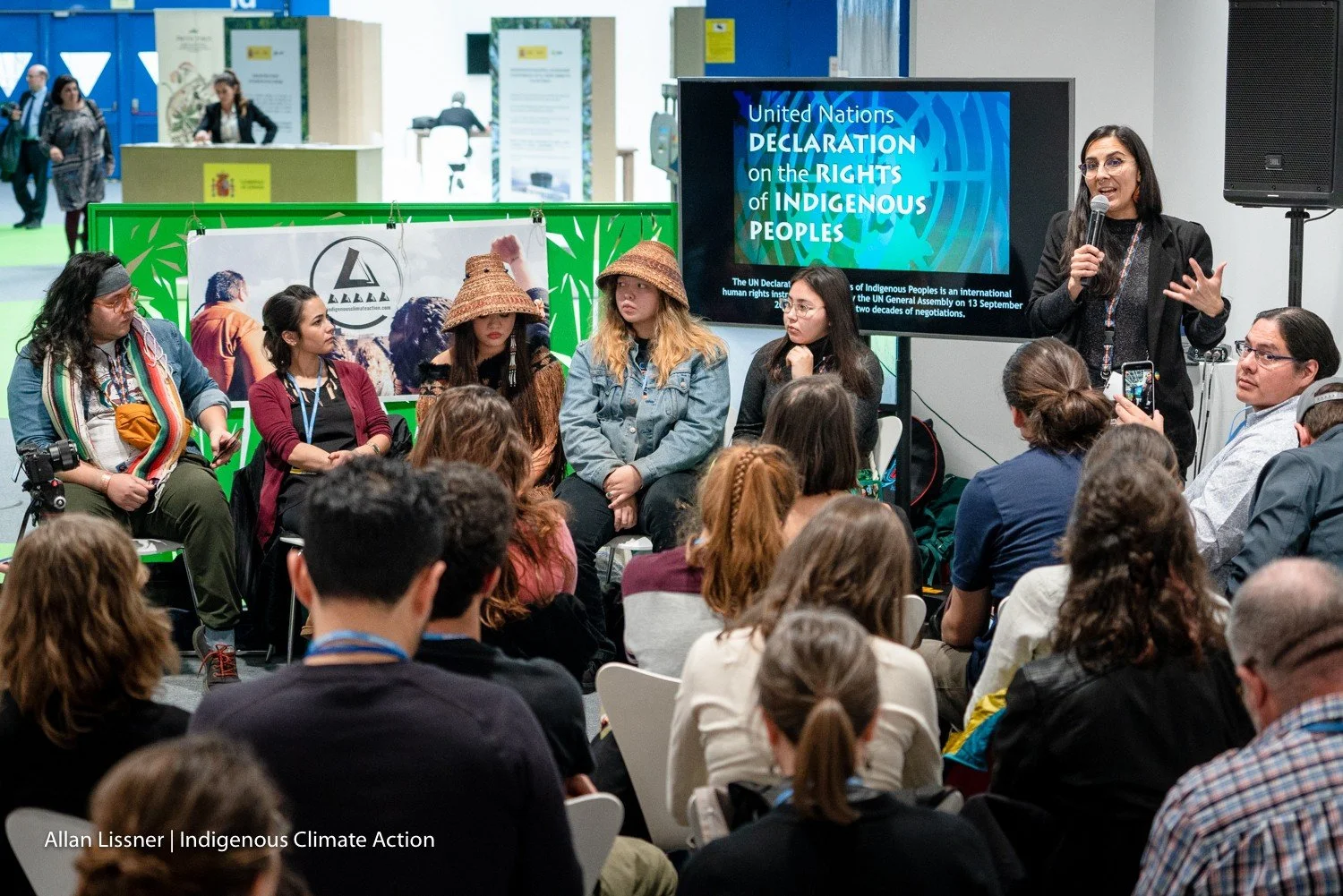
Photo Credit: Allan Lissner / ICA
I want to leave you with a provocative phrase I first came across about a decade ago. It said that we live in a world where more people are willing to imagine the end of the world than to imagine the end of colonial capitalism. We need the creativity to envision what exists after these systems are gone. How do we imagine a world outside of these structures? What becomes possible when we do? That is the call to action.